[ Article ]
Back to blogWebsite design costs explained: Why prices vary and what they include.

TL;DR: Web design and web development are different disciplines, each requiring distinct skills and expertise. Website design costs vary because providers include different levels of planning, design, development, performance optimisation, and long-term maintainability. Looking beyond the price and understanding what's actually included will help you choose a solution that delivers lasting value for your business.


Why website design prices differ so widely.
If you’ve ever searched for website design costs, you’ve probably noticed how widely the prices vary. One provider quotes a few hundred, another quotes several thousand, and both claim to offer “professional” web design. For business owners, that gap can feel confusing — or worse, arbitrary.
One of the biggest reasons website design prices vary so widely is that “web design” is often used as a catch-all term — when in reality, it covers very different skill sets.
A designer focuses on layout, hierarchy, usability, branding, and how information is presented. A developer focuses on how the site is built, how it functions, how it performs, and how it holds together over time. These are separate disciplines. Some professionals can do both — but many specialise in one or the other.
Expecting one role to automatically cover the other is a common misunderstanding, and it has a direct impact on cost.
It’s similar to asking a tyre fitter to install a gas boiler. Both work with tools. Both are skilled. But they solve entirely different problems, require different training, and carry different responsibilities. You wouldn’t judge the cost of one by the price of the other — and the same logic applies to websites.
Lower website design prices often reflect a narrower scope: visual templates, minimal development, or off-the-shelf solutions with limited flexibility. Higher prices usually include deeper planning, proper development, performance considerations, accessibility, and long-term maintainability — not just how the site looks on launch day.
When a quote seems unusually low or high, the important question isn’t “Why does this cost more?” — it’s “Which roles are actually being covered, and to what depth?”
That distinction is where most pricing confusion comes from — and understanding it helps businesses choose a solution that fits their goals, not just their budget.
What web design fees actually cover.
Once you understand why website design prices vary so widely, the more important question becomes: what do those fees actually cover — and what are you getting in return?
Website design shouldn’t be priced by page count, colour choices, or how quickly something can be launched. The cost reflects the amount of thinking, planning, and technical execution required to create a site that works reliably — not just on launch day, but as your business grows and conditions change.
A well-built website balances information architecture, design, development, performance, and usability. Each of those areas requires time, experience, and deliberate decision-making. When they’re done properly, the result is a site that supports your business rather than one that needs constant fixing, maintaining, updating, or replacing.
When that level of thinking is built into a website, it naturally extends beyond individual pages and into something more foundational: a reusable design system.
No matter the size of your business, a solid design system creates consistency and efficiency. It establishes clear rules for typography, layout, components, and interactions so your site isn’t rebuilt from scratch every time you need to add or update something.
There’s no single “Correct” price.
There is no universal price for website design because no two businesses have the same needs. A simple brochure site for a local service business has very different requirements from an ecommerce platform, a content-heavy site, or a system that integrates with third-party tools.
The cost of website design is shaped by factors such as:
- The amount of planning and strategy involved
- The level of custom design versus templated solutions
- Development complexity and performance requirements
- Accessibility standards compliance
- How easy the site will be extend over time
- How skilled the designer is, and at what seniority level
A lower quote in the £300+ range usually means two things. First, it’s unrealistic. Second, it often indicates that few — if any — of these areas are being properly addressed.
A mid-range to higher quote typically means more of them are being handled deliberately — not automatically, but intentionally.
Cheap, low-cost, and good value are not the same thing.
One of the most common misunderstandings in web design pricing is treating cheap and good value as interchangeable.
- Cheap websites prioritise speed of delivery and minimal effort. They often rely on pre-built templates, Wordpress, a plug-in for everything, limited customisation, and little consideration for performance, scalability, or long-term usability.
- Low-cost websites can be appropriate for very small projects with clearly limited needs, but they still involve trade-offs in flexibility and future growth.
- Good-value websites focus on solving the correct problems. They may cost more upfront or at handover, but they reduce friction, perform better, and last longer — ultimately lowering costs over time.
Most business owners aren’t looking for the cheapest website available. They’re looking for one that helps customers understand what they offer, builds trust, and supports real-world use across devices and connections — and if you’re a business owner, you should be too.
The biggest factors that influence website design prices.
Website design prices are shaped far less by how a site is built and far more by the thinking, planning, and decision-making that happens before anything is built at all. It comes down to design. Design cost reflects the work involved in structuring information, defining hierarchy, and creating layouts that support real user behaviour — not just how a site looks on the surface.
Understanding these factors helps explain why two designers can quote very different fees for what might appear, at first glance, to be a similar project.
Scope and design complexity.
From a design perspective, scope is about how much needs to be designed, solved, and communicated visually — not just how many pages exist.
A small site with a single, repeatable layout requires far less design work than a site where each section serves a different purpose, audience, or user intent. As scope increases, so does the amount of design thinking needed to keep the experience clear, consistent, and usable.
Unique page types — design effort and pricing.
Design effort is driven less by raw page count and more by the number of unique layouts and patterns a site requires. Ten pages that reuse the same underlying structure are far simpler to design than three pages that each demand a completely different layout, hierarchy, and interaction model.
The reason is that good design work is about creating systems, not one-off screens. Every strong designer should always think in terms of reusable components: content blocks, card patterns, navigation structures, and layout rules that can be applied consistently across any website or application. Once a component is thoughtfully designed, it can be reused in multiple contexts without rethinking spacing, hierarchy, or visual emphasis from scratch.
As those components accumulate, they naturally form the foundation of a design system. This isn’t a formal document for large teams only — it’s the shared logic that governs how headings behave, how content is grouped, how calls to action are presented, and how layouts respond to different types of information. Even small websites benefit from this level of consistency.
A design system reduces decision fatigue and prevents visual drift. Instead of reinventing solutions page by page, the designer works within a defined set of patterns that already support usability, clarity, and brand tone. This makes the design process more efficient while producing a more cohesive experience for users.
When every page is treated as a unique design, the work multiplies quickly. Each layout requires new decisions about information order, visual balance, and user focus. That level of bespoke thinking takes significantly more time — and directly influences website design pricing.
User flows and interaction design.
When a website is intended to guide users through specific actions — enquiries, bookings, sign-ups, comparisons — the design effort goes far beyond static layouts. This type of work requires a deep understanding of how people navigate, think, and make decisions online, and it is a critical factor in determining website design cost.
Designing effective user flows involves:
- Using data from user research, analytics, and testing to anticipate behavior and intent
- Prioritising accessibility standards to ensure all users, including those with disabilities, can complete actions without friction
- Reducing cognitive load at key decision points, so users can act confidently and efficiently
- Creating calls-to-action that are visible, reachable, and contextually timed for the user journey
- Accounting for edge cases, error states, and feedback loops to prevent frustration
Even before development begins, designing these flows requires deliberate planning, iteration, and testing. Unlike a brochure-style page, each interaction must be mapped and validated to ensure it aligns with user expectations and business goals.
A strong interaction design not only improves usability but also directly affects conversion, trust, and engagement — which is why seasoned designers should charge more for sites that include complex, data-driven user flows.
Design for integrations and features (planning, not building).
While developers implement integrations, designers are responsible for how those features are presented and used.
For example:
- How a booking flow is structured visually
- How forms are laid out to feel simple rather than overwhelming
- How errors, confirmations, and edge cases are communicated
Designing these experiences well takes more time than placing a generic form on a page — and that additional design effort is reflected in website design prices.
In essence:
Design cost increases with the amount of thinking required to make a site understandable, usable, and coherent. The more complex the goals, flows, and content structure, the more design work is involved — regardless of how the site is ultimately developed.
This is why experienced designers price based on scope and responsibility, not just deliverables — and why web design fees vary even before development is considered.
Template-based design: Two very different meanings.
The term template-based design is often used loosely, but it actually describes two very different approaches — with very different implications for quality, flexibility, and cost.
Pre-built templates (Often sold as “Website design”).
The most common form of template-based design is the use of pre-built themes — most often within platforms like WordPress, Wix and Squarespace. These templates come with predefined layouts, styles, and interaction patterns, designed to work for as many businesses as possible. My honest advice: if you truly value building a business online, it’s best to avoid these platforms altogether.
In this context, the “design” work typically involves:
- Choosing a theme
- Replacing placeholder images and copy
- Adjusting colours, fonts, and spacing within fixed constraints
- Adding plugins to fill functional gaps
While this can result in a somewhat presentable website on the surface, it’s important to be clear about what’s happening:
the design decisions have already been made, just not for your business.
This approach is best described as assembly, not design. The template wasn’t created with your users, content, or goals in mind — it was repackaged and applied. For many business owners, this distinction isn’t obvious, which is why template-based sites are often sold as “custom design” despite being anything but. That’s why it’s highly important to ask the right questions: How do you approach design? Can you talk me through your design process?
A useful comparison is mass-produced consumer products. You can buy an item directly from a factory overseas for a low cost, or buy the same item repackaged, renamed, and sold under a familiar brand at a much higher price. The product itself hasn’t fundamentally changed — only the presentation and marketing around it.
Template-based sites prioritise convenience over intention. That keeps the initial price low, but it also explains why many businesses encounter limitations once real-world demands begin to exceed the template’s assumptions.
Templates built by designers (Components & page templates).
There’s a very different meaning of “template” in professional web design and product design — one that experienced designers actively rely on.
In this context, templates aren’t downloaded or imposed. They’re intentional, reusable structures that emerge from a design system built around well-considered components: headers, content blocks, cards, navigation patterns, and calls to action. Each component is designed with purpose, tested in context, and reused consistently across the site.
This is how large organisations approach design at scale. For example, the IBM Design System is built entirely around modular components and layout patterns that combine into page templates. Individual pages may look different on the surface, but they share a common structural language — ensuring consistency, accessibility, and usability across thousands of pages and products.
Rather than restricting design, this system-led approach:
- Improves consistency and visual clarity
- Reduces cognitive load for users
- Makes content easier to extend and maintain
- Supports accessibility and responsive behaviour by default
When individual components are combined, they form a page template — a repeatable arrangement of content blocks that defines structure, hierarchy, and interaction patterns. These templates can then be reused across multiple pages without redesigning from scratch each time.
For example, a services page, case study, or article may all use the same underlying page template. The layout remains familiar, while the content, emphasis, and messaging change. The value lies in the design decisions being made once — deliberately — rather than improvised or reworked on every page.
In this sense, a template isn’t a pre-packaged solution imposed from the outside. It’s the outcome of a considered design process. The structure is reusable, but the thinking behind it is specific to the business, its content, and its users — not generic, and not accidental.
Why this difference matters for pricing.
Both approaches use the word template, but the effort involved is entirely different.
Pre-built templates minimise design effort by reusing someone else’s decisions. Page templates require upfront thinking, planning, and iteration — but they scale better, adapt more easily, and avoid costly redesigns later.
That’s why custom web design often costs more upfront: you’re not paying for uniqueness for its own sake — you’re paying for a system that works now and continues to work as your site grows.
Data-driven strategy and content planning.
Effective website design starts with data, not colour palettes or layout choices. Before visuals are refined or interactions are prototyped, designers need to understand who the site is for, what the users want, and how content should flow. This ensures that design decisions are rooted in real-world behaviour rather than assumptions.
Research and user insights.
Every design decision should begin with data. This includes:
- User research and behaviour analytics: Understanding how users navigate current websites, what they engage with, and where they drop off.
- Competitor analysis: Identifying strengths and weaknesses in similar sites to inform structure and hierarchy.
- Accessibility considerations: Ensuring content and interactions work for users with different abilities, meeting WCAG standards.
- Market and business data: Aligning design with business goals, target demographics, and measurable outcomes.
By grounding design in data, businesses avoid guesswork and create sites that actually perform. See our article on designing a website for a small business that covers user insights, success metrics and why data is so important.
Copywriting and messaging clarity.
Content drives design, not the other way around. Designers rely on clear, well-structured messaging to establish hierarchy, highlight key information, and guide users toward meaningful actions.
- Poorly defined copy or late-stage content creation forces designers to make assumptions, leading to inconsistent layouts and weak user experiences.
- Collaborative content planning ensures that every section, heading, and call-to-action has a purpose and supports user goals.
This strategic approach transforms design from decoration into a tool for communication, conversion, and trust-building.
SEO Foundations start with design.
Search engine visibility isn’t only about keywords—it’s about how information is organised and presented. Good designers should always prioritise users first, search engines second, while shaping content in ways that support both usability and discoverability.
Designers play a key role in:
- Creating clear heading hierarchies and logical page structures
- Grouping related content for scannability and comprehension
- Establishing internal linking patterns for user navigation and SEO
- Positioning key information and calls-to-action for maximum impact
By embedding SEO considerations into the design phase, sites are better optimised organically from day one—without relying on post-launch tweaks.
Content structure and hierarchy.
A website’s hierarchy is critical to guiding user attention. Strategic design clarifies:
- Primary content: What users must see first
- Supporting content: Information that reinforces the main message
- Secondary content: Details that are helpful but not urgent
This reduces friction, builds trust, and improves decision-making. Polished visuals alone cannot compensate for poor content order or unclear messaging.
Why this affects cost.
Designing around data, content, and strategy requires more upfront effort than decorating pre-made layouts.
It involves:
- Gathering and analysing user and business data
- Structuring content and interactions to reflect real behaviour
- Planning for scalability and future content growth
Whilst invisible on launch day, this work ensures a website functions as a business tool, not just a brochure. This is why professional website design is priced higher than template-based solutions: the investment covers research, strategy, and thoughtful implementation that continues to deliver value long after the site goes live.
Outcome.
When content, SEO, and strategy are integrated into the design process from the start, the result is:
- Clear communication of your brand and offerings
- Optimised discoverability and user engagement
- A scalable, maintainable site that grows with your business
Data-driven design ensures your website performs in the real world, across devices, connections, and user behaviours, rather than simply looking good on a single screen.
Website design pricing models explained with real-world costs.
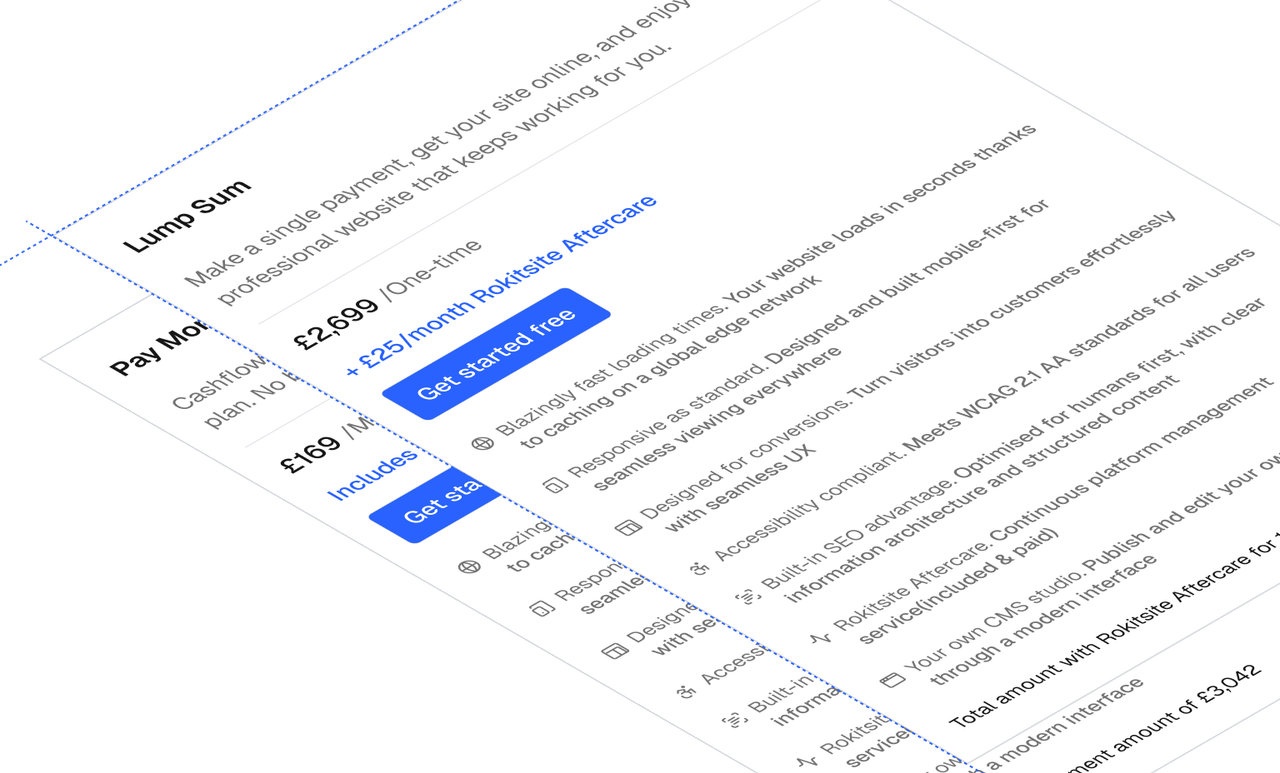
Website design pricing isn’t just about how much you pay — it’s also about how you pay. Different pricing models exist because businesses have different needs, budgets, and levels of certainty at the outset.
Understanding these models helps you choose an arrangement that fits your situation, rather than being surprised by costs later.
Fixed-price website design.
With fixed-price website design, the scope and cost are agreed upon or outlined upfront. This model works best when the project is clearly defined—ideally by a professional designer, agency, or service that understands both the business goals and user needs through extensive industry experience.
When the requirements are carefully outlined and documented, these providers often have established systems and processes, and may adopt Lean working practices to maximise efficiency and reduce waste. This allows them to justify a fixed scope, confidently estimate the time, resources, and design effort required, and minimise the risk of scope creep or unexpected costs.
Fixed-price arrangements provide predictability for both the client and the designer: you know exactly what will be delivered and at what cost, while the designer can plan their workflow efficiently without worrying about constant adjustments. The key is that the “fixed” price is based on thoughtful, deliberate planning—not on guessing or cutting corners.
Why businesses choose it:
- Predictable costs with no surprises
- Easier budgeting and internal approval
- Clear expectations around deliverables and timelines
What you can expect to pay:
For small brochure websites, fixed-price projects might start in the low £1,000–£2,500 range. Medium-sized or more feature-rich sites often cost £3,000–£10,000+, depending on custom design, content strategy, and UX planning.
Fixed-price projects reward good planning. The clearer the goals, content, and requirements at the start, the smoother the process — and the more accurate the pricing.
Hourly web design rates.
Hourly web design rates charge for time spent rather than a fixed outcome. This model is often used for ongoing work, small updates, or exploratory design where the scope isn’t fully known.
Why businesses choose it:
- Flexible for evolving or open-ended work
- Suitable for design support, iteration, or consulting
- No need to define everything upfront
Trade-offs to consider:
- Harder to forecast total cost
- Can escalate quickly without clear boundaries
- Requires trust, communication, and regular check-ins
What you can expect to pay:
Designers typically charge anywhere from £20–£150 per hour, depending on experience and location. A small set of updates may take 5–10 hours, whereas designing a new landing page or microsite could require 20+ hours.
Hourly pricing works best when there’s a clear working relationship and an understanding of priorities. Without structure, it can feel unpredictable — even if the hourly rate itself is reasonable.
Pay monthly website design.
Pay monthly website design (not to be confused with retainers or ongoing “maintenance”) allows businesses to spread the cost of a website’s design over time, rather than paying a large upfront fee.
This model is about financing the design work, not subscribing to continuous changes. The design scope is still defined upfront — it’s simply paid for in installments instead of as a single payment. For many smaller businesses, this lowers the barrier to accessing professional design without compromising on quality.
A useful way to think about it is like buying a new iPhone on a contract. You’re not renting the phone, and you’re not paying indefinitely. The cost is spread over 12–18 months, and once the term ends, you own it. Pay-monthly website design follows the same principle: the work is delivered, payments are spread, and ownership transfers once the agreement is complete.
What It typically includes:
- Lower upfront commitment — the full design cost is divided into manageable monthly payments rather than a single large invoice.
- A clearly defined design scope — layout, structure, content, and hierarchy are defined upfront, even though payment is spread over time.
- Early access to the finished design — the website is usually delivered well before the final payment, rather than being withheld until the end.
- Predictable costs — fixed monthly payments make budgeting easier, especially for newer or growing businesses.
The “monthly” aspect refers purely to the payment structure and does not imply ongoing or unlimited changes, updates, or maintenance.
Things to be aware of:
- Total cost over time — spreading payments can result in a higher overall cost compared to paying upfront, depending on the provider.
- Ownership and exit terms — some agreements retain ownership until the final payment is made or restrict transferring the design elsewhere. These terms should always be checked carefully.
- Scope is still finite — pay monthly doesn’t mean unlimited revisions or open-ended design changes. Anything outside the agreed scope is typically priced separately.
- Quality varies by provider — some pay-monthly services offer genuinely considered design, while others rely on lightly customised templates. The payment model alone doesn’t indicate depth or expertise.
Pay monthly website design works best for businesses that want professional, considered design, but prefer to spread the financial commitment over time — just like financing a high-value product rather than lowering expectations to fit a one-off budget.
What you can expect to pay:
Monthly plans often range from £29–£500 per month depending on the scope, support level, and included services. Over 12–24 months, the total cost may match or exceed a one-time fixed-price project, but spreads cash flow and often includes ongoing maintenance.
This model can be a good fit for businesses that value predictability and support over full ownership from day one. Like any pricing structure, the value depends on what’s included — and what isn’t.
Practical advice from experience.
Approach very low-cost monthly plans from any provider (for example, £29-£50) with caution. If you’re expecting Rolls-Royce craftsmanship, performance, and attention to detail, it’s worth remembering that pricing usually reflects what’s being delivered under the surface — you’re far more likely to end up with a Lada. Expectations should match reality.
Value based pricing.
Value-based pricing focuses on the impact a website has on a business, rather than the number of hours worked, pages designed, or tasks completed. It shifts the conversation from “How much time did this take?” to “What results does this website deliver?”
Instead of charging purely for effort, resources, or the number of deliverables, designers using value-based pricing assess the tangible benefits the website will provide. This can include:
- Increased leads or conversions — ensuring the site drives measurable business outcomes.
- Enhanced brand credibility and trust — creating a professional, cohesive experience that reassures visitors.
- Reduced friction in user interactions — improving usability so visitors can find information or complete actions more easily.
- Long-term efficiency and scalability — designing systems, templates, and reusable components that save time and resources as the business grows.
Pricing is then set relative to the expected return on investment, rather than simply reflecting hours worked or resources used. This approach encourages designers to think strategically about the business, content, and user experience, rather than just creating a visually appealing website.
The result is a website designed not just to “look good,” but to deliver measurable value, aligning design decisions directly with business goals and user needs.
What It typically includes:
- Strategic design planning — understanding business goals, user behaviour, and conversion objectives before any layouts are created.
- Content, SEO, and UX alignment — ensuring that every design decision directly supports measurable business outcomes.
- Tailored interactions and journeys — custom flows, calls-to-action, and page templates designed to maximise engagement and conversions.
- Performance and scalability considerations — designing for long-term usability and adaptability as the business grows.
How it works:
- The designer or agency evaluates the potential ROI of the website for the business.
- Pricing is set based on expected business impact rather than hours, templates, or arbitrary rates.
This often results in higher upfront costs, but the website is treated as an investment rather than a commodity, with a focus on long-term value and efficiency.
Things to be aware of:
- Not all designers offer value-based pricing — it requires experience, business insight, and confidence in delivering measurable results.
- Transparent objectives are essential — the business and designer need agreed-upon goals to determine what “value” means in practice.
- Costs may exceed traditional pricing models — but the focus is on the return and impact rather than the fee alone.
What you can expect to pay:
Value-based pricing often results in higher upfront costs because it reflects the website’s potential impact:
- Small business sites: £4,000–£10,000 — simpler projects with measurable business goals, but still strategic in design.
- Medium business sites: £10,000–£25,000 — more complex design, reusable components, content strategy, and performance considerations.
- Large or enterprise-level projects: £25,000–£50,000+ — extensive UX research, multiple page templates, integration planning, and ROI-focused design decisions.
This model treats your website as a strategic business asset rather than a commodity, aligning design decisions directly with measurable business outcomes.
Low-cost website design — what you gain and what you lose.
Low-cost website design is a high-volume search term for a reason: many small businesses want a web presence without a large upfront investment. But it’s important to understand what “low cost” actually means in practice, and the trade-offs it involves.
What low cost website design usually means.
Low-cost websites tend to be very small projects with clearly limited needs, but they still involve trade-offs in flexibility and future growth.
- Pre-built templates or themes — minimal customisation, often visually similar to other sites.
- Limited planning or research — little focus on content strategy, user flows, or business goals.
- Basic functionality only — essential pages and features with few interactive elements.
- Minimal optimisation — performance, accessibility, and SEO may not be fully considered.
In short, low cost usually covers the surface-level look of a website rather than the deeper work that makes it effective, scalable, and reliable.
Think of hiring someone inexperienced to fill a senior role because they’ll “do the job for less.” In theory, they might manage, but the lack of experience and foresight almost guarantees missed opportunities, mistakes, and costly fixes later. Low-cost web design works the same way — you’re paying less upfront, but the trade-offs often show up in performance, usability, and long-term maintainability.
Common trade-offs.
Opting for a low-cost website comes with trade-offs that can impact your business over time:
- Performance issues — slow load times, poorly optimised images, and limited mobile responsiveness.
- SEO limitations — weak content structure and hierarchy can reduce search visibility.
- Limited brand differentiation — template-based sites often look generic and may not fully reflect your business identity.
- Hidden constraints — restricted customisation, inflexible layouts, or locked plugins can prevent the site from evolving with your business needs.
One to pay close attention to:
Maintainability challenges: difficulty updating content, adding features, or scaling without relying on the providers. More often than not, low-cost sites use pre-built WordPress or Wix templates that don’t provide full administrator rights. This means you can’t make updates or changes yourself without paying extra, with many of these necessary changes often being mis-sold as “maintenance.”
These limitations are the natural outcome of a lower investment in strategy, design, and long-term thinking.
What you can expect to pay.
Low-cost website design typically ranges from £49–£750, depending on scope, template use, and minor customisation. These projects often deliver a semi-functional site quickly but may require additional investment later for optimisation, updates, or enhancements.
The key is aligning expectations: low cost meets short-term needs but rarely supports long-term growth, flexibility, or a polished user experience.
Website redesign costs — when starting over makes sense.
Redesigning a website isn’t just cosmetic. It’s about determining whether your current design can support your business goals, user experience, and branding — or if starting over is necessary to achieve clarity, usability, and impact.
When redesigning Is better than patching.
Sometimes, updating an old design is like repainting a cracked wall: it might look better temporarily, but the underlying problems remain. In many cases, businesses think a few visual tweaks will fix performance or usability issues — but without addressing the root design problems, the impact is short-lived. A thoughtful redesign uses data, business goals, and user behavior as the foundation for every design decision, rather than relying on guesswork or cosmetic changes.
Signs a redesign is the smarter choice.
- You have zero data points to reference. If your current design was created years ago, it may have been based on assumptions about your audience rather than measurable behavior. Modern redesigns start with real data — user flows, engagement metrics, and conversion patterns — so that every layout decision solves actual problems. Without this foundation, visual changes alone can’t improve performance or usability.
- Visual hierarchy is confusing or inconsistent across pages. When headings, sections, and content compete for attention, users struggle to find what matters most. Over time, businesses often layer new content onto outdated layouts without rethinking hierarchy. A redesign allows designers to reassess which information should be prioritised, supported data.
- Branding, colours, or typography no longer reflect your business identity. Businesses evolve, and your website should reflect that. A redesign ensures that visual elements, typography, and colours align with updated brand guidelines, positioning, and messaging. It’s not just about looking “pretty”; it’s about making sure the design communicates your current value proposition clearly and consistently.
- Layouts fail to guide users toward key actions or conversion points. Design is a strategic tool, not decoration. If your pages don’t naturally lead users toward enquiries, sign-ups, purchases, or other business goals, you’re leaving value on the table. Redesigns can redefine content placement, call-to-action prominence, and flow sequences to ensure every page supports measurable business outcomes.
- Page templates or components have become inconsistent, creating a fragmented experience. Over time, sites often accumulate a mix of legacy page templates, one-off page designs, and reused components that no longer fit together cohesively. This creates cognitive friction for users and undermines brand credibility. A redesign allows designers to rebuild consistent page templates and component libraries, ensuring reusable layouts that scale and adapt as content grows.
In short, a redesign is not just about refreshing visuals. It’s about re-aligning your website with current business goals, user data, and brand identity. By tackling the underlying design foundation, you prevent the accumulation of fragmented elements, inconsistent messaging, and lost opportunities — ensuring your site works as an effective business tool, not just a decorative placeholder.
What drives website redesign pricing.
Design-focused redesign costs depend on several factors:
- Scope of visual changes: Minor tweaks versus complete layout overhauls
- Page templates and components: Reusable design systems, content blocks, and interactions
- UX and interaction design: Optimising flows, calls-to-action, and user journeys
- Content presentation: Improving clarity, hierarchy, and emphasis through typography, spacing, and layout
- Accessibility and readability: Ensuring designs meet user needs across devices and pixel ranges.
How to evaluate redesign quotes properly.
When reviewing quotes for a redesign, focus on design deliverables:
- Which design roles are being covered: visual design, UX, content structuring, and strategic layout
- Consider long-term flexibility: does the new design allow content and pages to grow without redoing layouts?
Redesigns fail most often when businesses try to “save” a visually broken foundation. Understanding what drives design costs ensures your investment results in a cohesive, functional, and scalable user experience.
What you can expect to pay
Design-focused redesign costs vary depending on complexity and page count:
- Small brochure sites: £1,500–£4,000
- Medium content-heavy sites: £4,000–£10,000
- Large or multi-template enterprise sites: £10,000–£20,000+
These ranges reflect the effort required to restructure layouts, optimise visual hierarchy, and create reusable components — not technical development. A well-designed site reduces confusion, builds trust, and prepares your business for long-term growth.
In reality, a proper redesign is often as involved as building a brand-new site. Experienced designers don’t simply tweak visuals; they start by analysing user data, business goals, and content structure to inform layout, hierarchy, and interactions. Whether refreshing an old site or starting from scratch, the design process should be rooted in research and strategy, ensuring that every decision supports usability, clarity, and measurable business outcomes.
Choosing a website design company — what you’re really paying for.
Hiring a website designer—whether that’s an agency, service, or freelancer—isn’t just about buying a service; it’s about investing in a set of capabilities, judgement, and long-term value. The cheapest quote rarely wins in the long run; the right partner saves time, money, and headaches. This information is intended to help you evaluate proposals like an informed buyer—looking for strategy, experience, and the ability to deliver outcomes, not just visually appealing pages.
Strategy vs execution — pay for thinking, not just doing.
What you want: a partner who starts with business goals and user data, then translates them into a clear design strategy. That strategy is the blueprint that makes the execution efficient and effective.
How to check:
- Ask for an outline of their discovery process (user research, analytics review, stakeholder workshops).
- Look for deliverables such as personas, journey maps, or evidence of A/B testing.
- Request examples where research informed measurable outcomes (higher conversion, lower bounce).
Red flag: a proposal that jumps straight to mock-ups with no research or documented strategy.
Experience vs output — senior judgment matters.
What you want: designers who bring decision-making experience (not just pixels). Senior designers spot problems early, reduce rework, and create design systems that scale.
How to check:
- Review case studies and ask about the designer’s role and seniority.
- Request examples of reusable components or design systems they created.
- Ask for references from similar industries or project sizes.
Red flag: portfolios full of screenshots but no explanation of the problem solved or the role the team played.
One small caveat: most processes are a designer’s bread and butter, and many will not openly disclose them. Instead, ask for live links or working examples that let you experience the solution in context.
Long-term partnership vs one-off delivery — think beyond launch.
What you want: a provider who considers the site’s lifespan —scaling, and evolving business needs — rather than a one-off delivery that’s obsolete in 18 months.
How to check:
- Clarify what’s included post-launch: minor tweaks, training, and handover documentation.
- Ask about design processes that make future updates predictable (component libraries, templates, documented patterns).
- Understand ownership and exportability of design assets and content.
Red flag: vague handovers, no documentation, or restrictive clauses that make moving providers costly.
Pricing signals and transparency.
Hiring a website designer — whether an agency, service, or freelancer — isn’t just about buying a service. It’s about investing in a set of capabilities, judgement, and long-term value. The cheapest quote rarely wins over time; the right partner saves money, time, and unnecessary headaches.
This information helps you evaluate proposals like an informed buyer, focusing on strategy, experience, and the ability to deliver outcomes — not just visually appealing pages.
How to judge value, not just cost.
Think in terms of total cost of ownership: an inexpensive site that needs redesigning in two years will cost more than a higher-quality design that lasts and scales. The right partner reduces future redesigns, improves conversions, and frees your team to focus on growth.
Final checklist for a selective decision:
- Evidence of research and data-led decisions
- Live products
- Clear deliverables and a documented process
- Senior design involvement and reusable components or a design system
- Transparent pricing and ownership terms
- Post-launch support, handover, and exit clarity
Choosing a website design company is a strategic decision. Be selective, ask the correct questions, and pay for insight and longevity — not just pages delivered.
Cost vs value — making the right website investment.
When evaluating website design, the conversation shouldn’t stop at the upfront price. The real cost is what a site costs your business if it underperforms — missed leads, confused visitors, or a site that can’t grow with you.
A website that’s designed thoughtfully is an investment, not an expense. It delivers measurable value across multiple dimensions:
- Converts better: Clear visual hierarchy, purposeful layouts, and intuitive interactions turn visitors into leads, subscribers, or customers. A site that “just looks nice” but doesn’t guide user behaviour is a missed opportunity.
- Scales with your business: Design decisions that account for content growth, reusable components, and flexible Page templates mean your website can adapt as your business evolves. Avoid costly redesigns or patchwork solutions down the line.
- Reduces future redesign costs: By starting with data, strategy, and reusable design systems, you’re not paying for quick fixes — you’re paying to get it right the first time. This reduces the likelihood of fragmented layouts, inconsistencies, or visual and functional debt that must be corrected later.
The takeaway.
Upfront cost is only part of the story. When you focus on value rather than price, the right website design becomes a tool for growth, efficiency, and long-term credibility. Investing in design expertise ensures your site doesn’t just exist — it performs, scales, and supports your business objectives.
Your business website: An investment, not an expense.
If you’re planning a new website or a redesign and want clarity on what you actually need — not just what you’re being sold — start with a conversation, not a price list. A £3,000 website that generates leads, builds trust, and scales with your business is far cheaper in the long run than a £1,000 site that looks okay but does nothing.
Investing in the right designer ensures your website is not just a digital presence, but a business tool that drives measurable results and avoids costly rework down the line.
[ Good reads ]
Related articles.
View all the related news and articles from Rokitsite.
Responsive design for real-world use —beyond the feature list.
We’ve all heard of responsive design by now — or at least we should have. It’s often presented as a selling point by web design companies, usually tucked into a...
 Read articleRead article
Designing a website for a small business —lessons from product design.
It’s tempting to jump right in and start the process of designing a website for a small business — shop around for what feels like the best option, even jump on...
 Read articleRead article